Utility bills are often treated as static documents, something to pay and file away.
In reality, they contain a continuous stream of operational, financial, and performance data. When analyzed correctly, that data can uncover cost savings, identify inefficiencies, and guide investment decisions across your entire building portfolio.
Below are ten real insights derived directly from utility bill analysis, each tied to measurable impact:
1. You May Be Locked into the Wrong Utility Rate
A single spike in peak demand can push a building into a higher rate class and keep it there long after the spike is gone. In many cases, this happens automatically and goes unnoticed, quietly increasing costs month after month. Without ongoing review, buildings can remain misclassified indefinitely.

Example:
A building exceeded 50 kW demand for three consecutive months three years prior and remained in a higher rate structure.
Impact:
Unnecessary cost premiums every billing cycle.
Opportunity:
Rate review and reclassification can immediately reduce spend without operational changes. Many organizations never revisit their rate classification after an initial change, meaning they continue overpaying by default. Regular audits ensure your rate structure reflects current usage, not historical conditions.
2. Your ENERGY STAR Score May Be Underreported
Building performance scores are only as accurate as the data collected. Even small data gaps or outdated inputs can prevent a building from reaching its true performance potential. This creates missed opportunities for recognition, incentives, and competitive positioning.
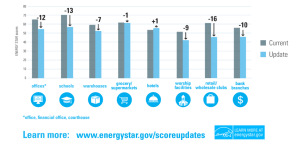
Example:
A building with a score of 73 actually qualified for a 76 after updating attributes, crossing the threshold for certification.
Impact:
Missed certification opportunities and reduced asset valuation.
Opportunity:
Routine data validation can unlock compliance and recognition benefits. Small inaccuracies in square footage, occupancy, or operating hours can materially impact scores. Keeping this data current ensures performance is properly reflected and recognized.
3. Energy Projects Reveal Their True ROI in Billing Data
Utility bills provide the most objective validation of energy project performance. They eliminate assumptions and show exactly how improvements translate into financial outcomes over time. This makes them one of the most reliable sources for measuring success.

Example:
A controls upgrade delivered $4,600 savings in its highest-performing month and $73,000 total savings over 15 months.
Impact:
Clear ROI tracking and vendor accountability.
Opportunity:
Use billing data to validate and optimize energy improvement investments. This level of visibility allows teams to confirm whether projected savings are actually realized. It also creates a feedback loop to improve future project selection and execution.
4. Weather Normalization Exposes Hidden Inefficiencies
Energy usage should correlate with weather patterns. When it does not, something is off. Without adjusting for actual weather conditions, it is easy to misinterpret performance and overlook underlying operational issues. Normalization provides the context needed to separate true inefficiencies from seasonal variation.
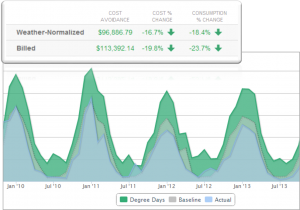
Example:
A winter that was 6% warmer still resulted in a 7% increase in utility costs.
Impact:
Undetected inefficiencies, often tied to system settings or overrides.
Opportunity:
Identify and correct operational issues like HVAC setpoints. Without normalization, these issues can be mistaken as seasonal variability. Comparing usage against weather-adjusted expectations makes anomalies easier to detect and resolve.
5. Demand Charges May Be Driving a Disproportionate Share of Costs
Many building owners underestimate the impact of demand charges. These costs are often less visible than consumption charges but can represent a significant portion of total spend. Without actively monitoring peaks, they can escalate quickly.
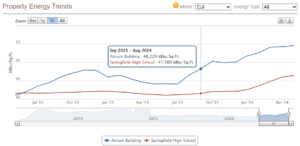
Example:
A hospital spent 40% of its utility costs on demand, well above national and state benchmarks.
Impact:
Significant cost exposure tied to peak usage patterns.
Opportunity:
Demand management strategies can yield immediate and recurring savings. Even small reductions in peak demand can have outsized financial impact. Understanding when and how peaks occur is the first step to controlling them.
6. The Highest Energy Users Are Not Always the Best ROI Targets
Energy consumption alone does not determine where to invest. Focusing only on usage can lead to missed opportunities where cost inefficiencies are actually higher. A more strategic approach considers both rate structures and cost intensity.
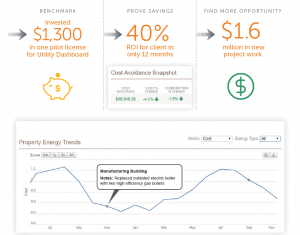
Example:
Three buildings were identified as top retrofit candidates not due to usage, but because their utility rates were 50% higher than others in the portfolio.
Impact:
Misallocated capital if decisions are based on usage alone.
Opportunity:
Prioritize projects based on cost intensity, not just consumption. This approach ensures capital is directed where it will generate the highest return. It also prevents overlooking smaller buildings that may have disproportionate cost inefficiencies.
7. Completed Projects May Be Underperforming
Installation alone does not guarantee results. Without baseline and post-implementation tracking, underperformance can persist unnoticed and erode expected returns. Verification is critical to ensure projected savings are actually achieved.
Example:
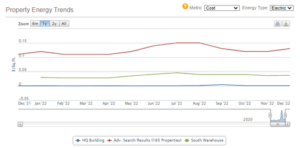
An LED upgrade reduced consumption by 9%, below expected ROI targets.
Impact:
Missed savings projections and unclear accountability.
Opportunity:
Ongoing monitoring enables course correction and vendor alignment. Without post-installation tracking, underperformance can go unnoticed for years. Continuous validation ensures projects deliver on their financial promise.
8. Time-of-Use Rates Can Unlock Immediate Savings
Utility pricing often depends on when energy is used, not just total consumption. Many buildings already operate in patterns that align with more favorable rate structures but never take advantage of them.

Example:
A building operating primarily during weekdays benefited from switching from a general service rate to a time-of-day structure.
Impact:
Lower cost per kWh without reducing usage.
Opportunity:
Align rate structures with operational patterns. Many buildings already operate in ways that qualify for more favorable rates. Identifying and switching to those structures can produce immediate savings without operational disruption.
9. Policy and Tax Changes Directly Affect Energy Costs
Utility bills reflect regulatory and policy shifts in real time. These changes can impact costs quickly, often without clear visibility into the cause. Staying ahead of them is critical for accurate forecasting and budgeting.

Example:
The expiration of a tax credit led to a projected 2% increase in gas costs.
Impact:
Unexpected cost increases without proactive planning.
Opportunity:
Forecast and budget more accurately with policy-aware analysis. Tracking these changes allows organizations to anticipate cost shifts rather than react to them. It also helps inform longer-term financial and operational planning.
10. Compliance Can Be Completed Earlier than Expected
Energy benchmarking and compliance do not need to be last-minute efforts. With the right data infrastructure and tracking in place, compliance can become a continuous process rather than a periodic scramble. This reduces risk and improves operational efficiency.
Example:
A client achieved compliance three months ahead of deadline.
Impact:
Reduced risk, improved reporting timelines, and better resource allocation.
Opportunity:
Centralized data tracking simplifies compliance across portfolios. Early completion reduces the risk of penalties and last-minute scrambling. It also frees up internal teams to focus on higher-value initiatives.
What This Means for Building Owners
Utility bills are not just records. They can be a powerful diagnostic tool.
Across EnergyPrint client portfolios, consistent utility bill analysis has delivered an average second-year savings of 12.7%, driven by:
- Rate optimization
- Demand reduction
- Operational adjustments
- Targeted capital investments
The key difference is not just access to data, it’s the ability to interpret and act on the delivered insights at scale.
Take the Next Step
If your utility bills are not actively driving decisions, they are leaving money on the table. Most organizations already have the data they need, but lack the systems and processes to turn it into action. That gap is where the biggest savings opportunities exist.
Connect with our solutions team to identify cost-saving opportunities across your buildings and turn utility data into measurable ROI.